


In season four of The Office, Ryan returns to Scranton to launch ‘Dunder Mifflin Infinity’, a push for new technology and sales initiatives within the flailing paper company.
A bunch of everyday office dynamics get shaken up at once:
Michael, ever the obtuse and lazy manager, fails to read the memo directing him how to use PowerPoint, leading to an awkward team meeting.
The rest of the Scranton office employees have mixed reactions to the new website ordering system and BlackBerrys.
Creed panics about being pushed out for being too old and dyes his hair jet black to seem more youthful!

Feeling threatened and insulted by the tech push and the implication that he’s obsolete, Michael then launches his “back to basics” counteroffensive. He drags Dwight on a gift‑basket road trip to win back old clients through personal charm instead of the new website.
The truth proves hard to take: those clients mostly tell Michael that they’ll only consider coming back if Dunder Mifflin improves its technology and pricing.
Everything Is Changing (Again)
UXR has largely been dealing with the effects of AI a little better than Michael did with Powerpoint. But there’s another change underway which might have us clutching at our gift baskets.
The launch of ChatGPT in November 2022 felt like the start of a seismic shift. Early 2026 represents another inflection point:
The launch of OpenClaw has made personal, autonomous agents realistic (albeit with security worries).
Posts from engineering leaders like DHH and Boris Cherny have outlined how AI reorients how developers write code.
Jakob Nielsen has written about how the entire field of UX is set to be upended by AI.
All of these developments point to an evolving tech landscape, but what’s most acute is the impact on engineering and downstream effects on product development.
To Code or Not to Code
Engineers are the load-bearing wall of any product organization. They write the code that creates the product. Of course, there are many other vital roles within software companies, but the team at the centre of it all is engineering.
Anecdotal evidence and data from AI-forward companies point to a rethink of this central task.
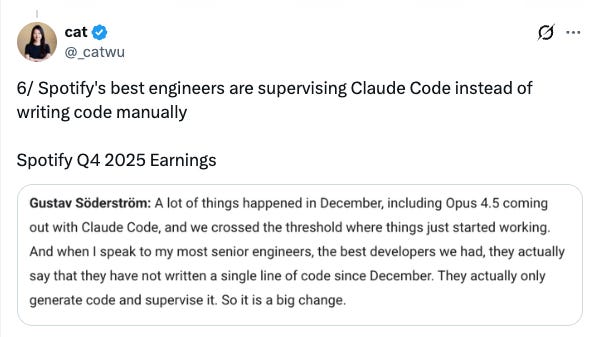
Of course, engineers do more than generate code, but the core activity within their role is code. What happens once a chunk of that work is passed to AI? Or maybe that’s too assumptive: does a chunk of that work get passed to AI?
For now, it’s unclear. But just a bit of educated guesswork brings up some possibilities:
Perhaps most alarmingly, junior-level engineering roles slowly dwindle. There’s already some evidence that these starter positions are going away. The long-term effect is a vacuum in the mid-level engineer space within the next decade, but let’s come back to the short-term.
Engineers become conductors, with more time spent on architecture and code review. If there’s less time spent on generating code, activity shifts to existing, adjacent work.
However, these options are incomplete. They miss the obvious change in calculus for product development.
When building is no longer expensive, how does the process of building change?
In my next post, I’ll play out different scenarios for engineering, PM, and design, then talk through the implications for UXR.